
Green Hell Doesn’t Want You to Survive — It Wants You to *Remember* You’re Human
Green Hell Doesn’t Want You to Survive — It Wants You to Remember You’re Human I spent 47 minutes and 12 seconds trying to stitch up a deep gash on my thigh with a needle made from a fish bone and th
Green Hell Doesn’t Want You to Survive — It Wants You to *Remember* You’re Human

I spent 47 minutes and 12 seconds trying to stitch up a deep gash on my thigh with a needle made from a fish bone and thread pulled from my own shirt. My hands were shaking. My character’s heartbeat was thumping so loud in the headphones I had to pause the game just to catch my breath — not because of tension, but because my actual pulse had spiked. That’s when it hit me: this isn’t a survival game. It’s a stress test disguised as software.
And yeah — I know that sounds pretentious. But play Green Hell long enough, and you stop thinking in terms of “crafting tiers” or “resource sinks.” You start noticing how your real-world posture changes. How you blink slower. How you forget to hydrate yourself while micromanaging your avatar’s hydration bar.
Not Another “Survive Until Tuesday” Simulator
Look, I’ve played every major survival title since DayZ beta — Rust, The Forest, Subnautica, even Don’t Starve on permadeath mode. Most of them treat hunger, thirst, and health as parallel meters you juggle like laundry loads. Green Hell doesn’t do that. It treats your body like a fragile, interconnected system — one where a mosquito bite isn’t just “-1 HP,” but the first tremor before full-blown malaria sets in, complete with hallucinations, fever dreams, and a slow, sticky erosion of your ability to tell real from imagined threats.
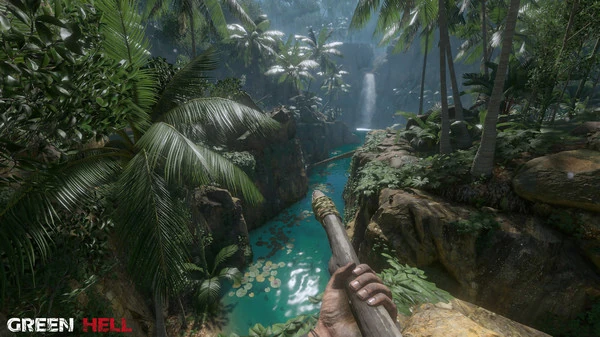
The jungle isn’t just there. It’s active. Vines snag your ankles. Mud sucks at your boots until stamina drains faster than you can regenerate it. Rain doesn’t just wet you — it rots your clothes, lowers your body temperature, and makes fire-starting feel like negotiating with gods who’ve already decided you’re not worth the effort.
And don’t get me started on the mental health system. It’s not some abstract “sanity meter” that fills up when you stare at trees for too long. It’s tied directly to sleep quality, nutrition, injury, isolation, and even whether you’ve spoken aloud (via voice chat in multiplayer) recently. Go three in-game days without sleeping properly? Your vision blurs. Sounds distort. You start seeing things, flickers in the periphery, whispers in the wind, that aren’t scripted events. They’re simulated breakdowns, seeded by your own choices. Creepy Jar didn’t build a mechanic. They built a feedback loop between player behavior and psychological consequence.
The Radio Voice Is the Best/Worst Companion Ever Made
You wake up alone. No tutorial. No HUD prompts. Just heat, humidity, and a cracked radio crackling with a woman’s voice — Dr. Archibald, your former colleague, now your only lifeline. She’s calm. Professional. Occasionally warm. But she never tells you what to do next. She’ll say, “Your left arm’s swelling — check for infection,” or “That vine’s toxic if ingested raw, boil it twice,” or, and this one got me — “You haven’t slept in 36 hours. Your judgment is compromised. Rest now, or don’t expect me to guide you through the next crisis.”
She doesn’t nag. She observes. And somehow, that makes her feel more real than most NPCs with full voice acting and branching dialogue trees. You start wanting to impress her. To prove you’re still you, even as your character’s mind frays at the edges. I caught myself apologizing out loud after botching a splint. (“Sorry, Doc. Won’t happen again.”) Which is absurd. And also kind of perfect.
Crafting Isn’t Satisfying — It’s *Necessary*
Forget Minecraft-style crafting menus. In Green Hell, making a water filter involves finding clay, shaping it over a stick, drying it in sun, then firing it in a fire pit — which itself requires building a proper kiln with layered stone and airflow control. Boiling water? You need a container and something to suspend it over flame and consistent fuel management. One misstep, a poorly sealed clay pot, an uneven fire bed, and you’re back to drinking contaminated water, rolling dice with dysentery.
This isn’t busywork. It’s tactile education. You learn why certain plants are antiseptic. You memorize which mushrooms rot in 90 minutes versus which stay edible for days. You realize, slowly, painfully, that “survival knowledge” isn’t about memorizing recipes. It’s about pattern recognition, cause-and-effect, and accepting that failure isn’t punishment — it’s data.
(Also, fair warning: the UI is intentionally clunky. Inventory management feels like sorting wet laundry in a moving canoe. This isn’t bad design — it’s design doing its job. You’re not meant to feel efficient. You’re meant to feel burdened.)
The Story Isn’t Unlocked — It’s *Earned*
There’s no quest log. No objective markers. The narrative unfolds in fragments: audio logs buried in collapsed huts, journal pages soaked and half-decayed, environmental storytelling so subtle you might miss it entirely unless you’re paying attention to how light falls through canopy gaps near a particular river bend.
The central mystery, why you’re here, what happened to the expedition, doesn’t drop into your lap. You piece it together by treating wounds correctly (which unlocks medical logs), by navigating specific biomes (which trigger memory flashbacks), by surviving long enough to trigger late-game encounters that reframe everything you thought you knew.
And yes — some of it is worse than the jungle. Not because it’s jump-scare horror, but because it’s quiet, human cruelty dressed in clinical language. The kind that makes you close the game, walk outside, and take three deep breaths of unfiltered air.
Who Is This For? Honestly?
Not for people who want to “win.” Not for speedrunners. Not for those who treat games like spreadsheets or optimization puzzles.
Green Hell is for people who’ve ever sat quietly in a forest and felt both utterly small and deeply connected — all at once. It’s for players who don’t mind losing, as long as the loss teaches them something real. It’s for anyone who’s ever stared at their own hands and wondered how much they really know about keeping themselves alive.
It’s exhausting. It’s occasionally infuriating. It’s not always fun — not in the dopamine-hit sense. But it sticks with you. Weeks later, I caught myself checking the humidity on my weather app. I paused mid-walk to examine a patch of moss on a tree trunk. I boiled tap water before making tea, just once, and smiled, weirdly, at the ritual.
That’s the thing Green Hell does better than almost any game I’ve played: it doesn’t simulate survival. It simulates attention. To your body. To your environment. To the thin, vital line between function and collapse.
So yeah — it’s brutal. And yes, it’s beautiful. And no, I wouldn’t recommend it to everyone.
But if you’ve ever looked at your phone, then at the sky, then back at your phone, and felt a little hollow, maybe try it. Just… maybe keep a glass of water nearby. For you. Not your character.
References & Further Reading
Loading comments...
Loading similar articles...