
Gran Turismo 7 Isn’t a Love Letter — It’s a Long, Slightly Exhausted Conversation With Itself
Gran Turismo 7 Isn’t a Love Letter — It’s a Long, Slightly Exhausted Conversation With Itself I spent 47 minutes trying to get a 1991 Mazda MX-5 Miata to stop fishtailing on the back straight of Suzu
Gran Turismo 7 Isn’t a Love Letter — It’s a Long, Slightly Exhausted Conversation With Itself

I spent 47 minutes trying to get a 1991 Mazda MX-5 Miata to stop fishtailing on the back straight of Suzuka. Not because it was fast, it wasn’t, but because I’d just slapped on a set of semi-slicks, cranked the camber to -3.2°, and forgotten that this car doesn’t have traction control, or ABS, or even power steering that isn’t actively judging you. I crashed. Then I tried again. And again. By attempt six, I was grinning like an idiot. That’s not realism. That’s recognition.
Gran Turismo 7 doesn’t pretend to be new. It leans hard into its own history — sometimes so hard it creaks. But it also quietly fixes things no one asked it to fix, adds layers no one knew they wanted, and stumbles over its own feet in ways that somehow make it more human than most AAA games released this decade.
The Café Is Weird. And It Works.
You walk into the Gran Turismo Café — yes, it’s a literal café with a guy in a bowtie and a chalkboard — and he hands you a laminated menu book titled “European Classics: 1960–1980.” You blink. He smiles. You go race a Lancia Fulvia, then a Triumph TR6, then a BMW 2002 Ti. Finish all three? You get a short, beautifully shot documentary clip — not CGI, not narration over stock footage, but real film grain, real engine noise, real historians explaining why the Fulvia’s transaxle mattered. It’s weirdly tender. Like Polyphony built a museum and forgot to put up velvet ropes.
Longtime fans roll their eyes, “Ugh, another tutorial slog”, but here’s the thing: those races are your career mode. They’re not filler. They’re how you earn your first 30 cars, your first proper licence, your first sense of progression. And unlike GT Sport’s cold, gamified grind, this feels curated. Intentional. Like someone sat down and thought: What if we taught people about cars the way we learned — by falling in love with one at a time?
It’s not perfect. Some menu books feel like padding (looking at you, “Modern Hybrids” — three Prius variants and a NSX-R? Really?). But the intent is refreshing. In a genre obsessed with stats and spreadsheets, GT7 occasionally remembers cars are objects of affection — not just data points.
Money? Yeah, You’ll Sweat Over That.
Let’s talk about the wallet. Or rather, the lack of one.
GT7’s economy is… deliberate. Not punishing, exactly — but insistent. Win a race? $12,400. Buy a decent set of tyres for your Evo VI? $28,000. Upgrade the turbo on your ’94 Supra? $92,000. And don’t even ask about that $140,000 carbon-ceramic brake kit. I once sold my entire garage, all 17 cars, just to afford a single aero package for a GT3 racer. I felt like a junkie trading furniture for another hit.
But here’s the twist: it works. Because scarcity makes choices matter. You can’t just hoard every variant of every car. You pick one NSX, the ’91, or the ’97, or the 2002, and live with it. You learn its quirks. You tune it until it breathes with you. That’s not artificial friction. It’s focus.
Also? The dealership prices are wildly inconsistent. A 2003 Honda S2000 costs $48,000. A 2019 Porsche 911 GT3 RS costs $215,000. A 2022 Toyota GR Yaris? $39,500. Why? Who knows. But it means the game’s internal logic feels less like a spreadsheet and more like walking into a used-car lot run by someone who’s really into certain eras and really indifferent to others.
Handling: Where the Magic Lives
Look — if you’ve played any Gran Turismo since ’97, you already know how a Skyline R34 should feel coming out of Spoon Curve. Heavy front end, rear stepping out just enough to make you swear, then settling into a long, clean drift if you’re smooth. GT7 nails that. Not just the physics — the personality.
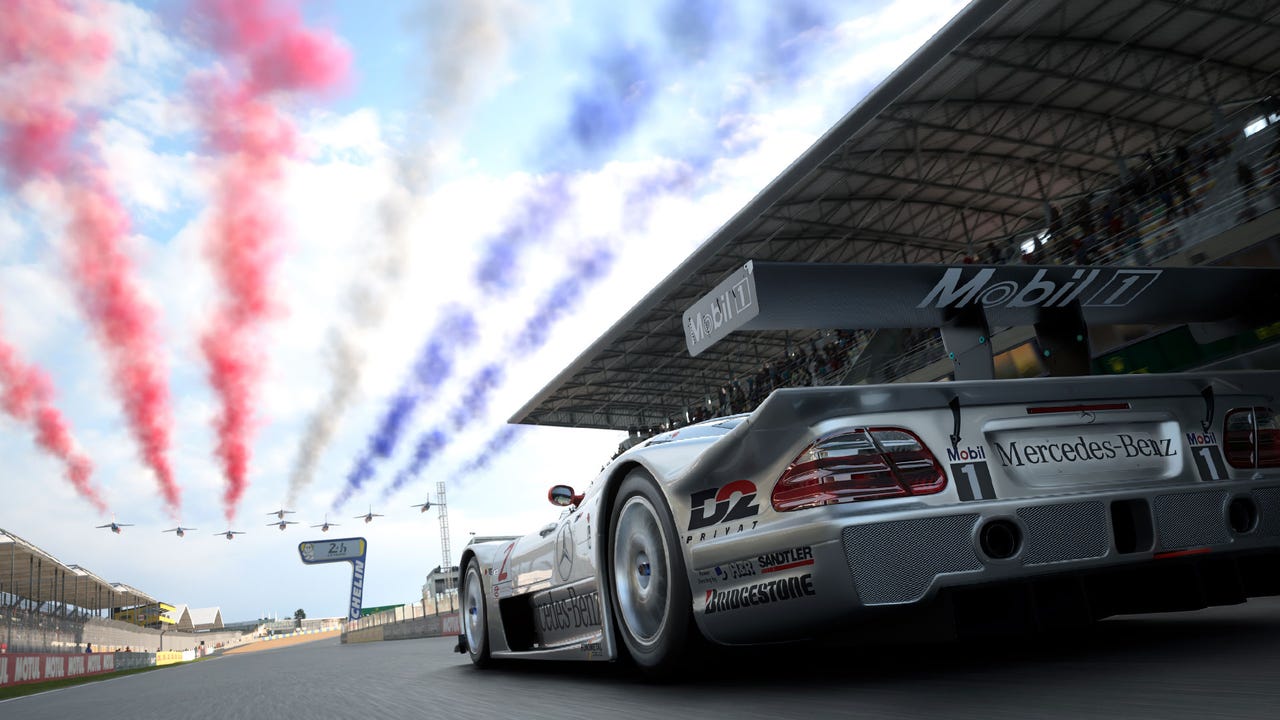
Older cars wobble. They breathe. They get nervous when you lift mid-corner. Modern supercars feel like they’re bolted to the road — until you yank the wheel and suddenly they’re rotating like a top. And race cars? Oh man. The LMP1s don’t slide. They pivot. One moment you’re on the edge, the next you’re sideways, and somehow, somehow, you catch it — not with magic, but with weight transfer, throttle modulation, and the faintest whisper of feedback through the controller.
The force feedback on DualSense is subtle but brilliant. Not flashy rumble — just a tightening in the wheel as grip fades, a slight buzz over curbs, a softening when you hit grass. It’s not “immersive” in the VR sense. It’s honest. Like the car’s telling you secrets.
(Though yes — off-road handling still feels like driving a shopping cart down a fire escape. Skip the dirt rallies unless you enjoy existential dread.)
The Garage Problem No One Talks About Enough
Here’s the awkward part: GT7 has 425+ cars. Sounds great — until you actually start browsing.
You’ll notice whole decades missing from certain manufacturers. No Lamborghini Huracán EVO? Check. No McLaren Senna? Yep. No Tesla Roadster (2020), no Rivian R1T, no Lucid Air — nothing post-2018 from most EV brands. Even Japanese domestic market icons like the latest GR Corolla or the 2023 Nissan Z feel… absent. Like Polyphony stopped updating the roster right before the pandemic hit and never quite got back on the horse.
It’s not incompetence. It’s licensing. And maybe fatigue. But it matters. Because when you’re deep in the Café’s “Modern Supercars” book and the newest option is a 2016 Ford GT, it starts to feel like staring at a photo album where the last few pages are just blank.
Still, — the quality of what’s there is staggering. Every car has working headlights, wipers, interior reflections, functional mirrors, and interiors modelled down to the stitching. I’ve spent 20 minutes just watching rain bead on the windshield of a 1970 Datsun 240Z while idling at a traffic light. It’s absurd. It’s beautiful. It’s also kind of ridiculous, given how many newer cars are missing.
So… Who Is This For?
Not the person who wants to jump in and win Le Mans after 20 minutes.
Not the sim racer who needs iRacing-level telemetry and mod support.
Not the casual player who expects a “casual mode” button that auto-brakes and auto-steers.
It’s for the person who watches Top Gear reruns and pauses to Google “what’s a limited-slip diff?”
It’s for the kid who still has a faded poster of a yellow NSX taped to their closet door.
It’s for the adult who realizes, halfway through a rainy lap at Nürburgring, that they haven’t checked their phone in 45 minutes.
Gran Turismo 7 isn’t trying to win awards for innovation. It’s trying, and mostly succeeding, at being the place where cars feel real, where learning matters, where progress is earned in sweat and tire smoke and that little jolt of joy when your tuned Miata finally sticks through Degner.
It’s slow. It’s fussy. It’s expensive in places that don’t need to be. But it’s also the only racing game I’ve ever played where I caught myself whispering “good girl” to a 1987 Toyota Corolla AE86 after it held a perfect drift around Fuji’s hairpin.
Yeah. I did that.
And honestly? I’m not embarrassed.
References & Further Reading
Loading comments...
Loading similar articles...