
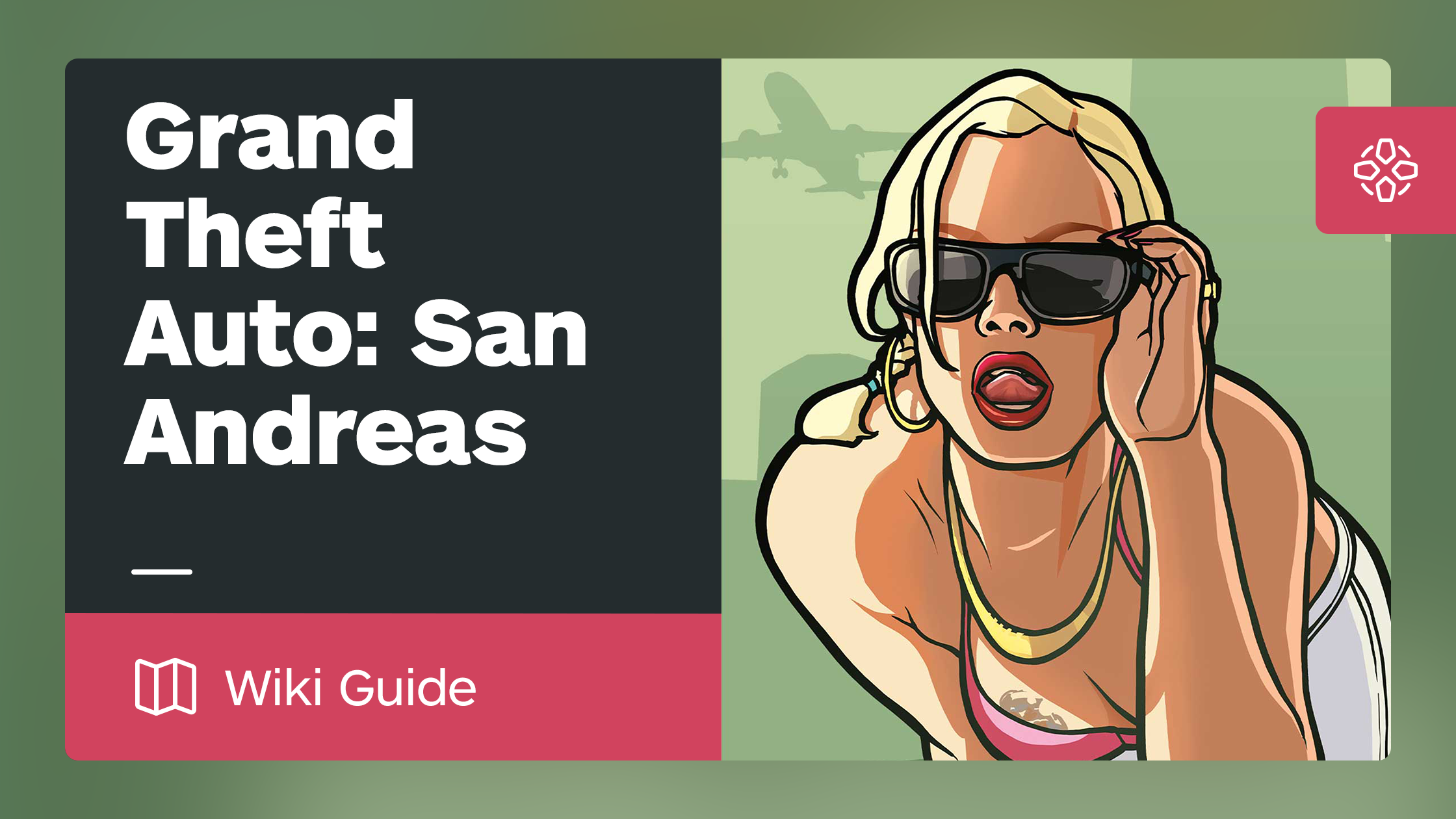
Why I Still Boot Up *San Andreas* When My Wi-Fi’s Down

I was reorganizing my Steam library last week—y’know, the kind of chore you do at 1 a.m. when you’re avoiding adult responsibilities—and there it was: Grand Theft Auto: San Andreas, sitting between Red Dead Redemption 2 and Cyberpunk 2077, looking weirdly unbothered by the passage of two decades. I clicked it. Not to “study its legacy” or “analyze its cultural footprint.” I clicked it because I suddenly remembered how good it feels to ride a BMX down a hill in Ganton, jump a fence into a backyard, and immediately get chased by a cop who somehow thinks stealing a lawnmower is felony-level chaos.
And yeah—I played for 47 minutes before remembering I had laundry in the dryer.
That’s the thing about San Andreas. It doesn’t ask for your full attention. It just… works. Like an old pair of sneakers. You don’t admire them—you wear them.
It’s Not a Game. It’s a Town You Keep Coming Back To
Look, I know the stats: 3 cities, 105 story missions, over 200 vehicles, 60+ side activities, and enough cheat codes to turn CJ into a flying, muscle-bound, rocket-launching, girlfriend-dumping, horse-betting, jetpack-riding paradox. But none of that matters unless the world breathes. And San Andreas breathes like few games ever have—not with fancy tech, but with stubborn, lived-in texture.
You feel it in the way Carl’s hair gets greasier if you skip the barbershop. Or how your stamina bar shrinks if you eat too many Big Smoke burgers (RIP, Smoke). Or how the radio stations actually change depending on which city you’re in—K-JAH in Los Santos, K-Rose in San Fierro, and V-Rock blasting out of a convertible in Las Venturas like it’s personally offended by silence.
Rockstar didn’t build a map. They built a rumor mill. You hear about the jetpack from some dude leaning against a payphone. Someone else swears there’s a tank buried under a construction site in Red County. Another guy insists his cousin saw a UFO near Mount Chiliad—but only if you’re wearing sunglasses and it’s raining. None of it’s essential. All of it makes the place feel real.
The Body Is a Menu
Remember when games treated your character’s physicality as set dressing? San Andreas made it a damn spreadsheet.
You gain muscle by lifting weights (not just pressing a button—actually going to a gym, picking a machine, watching CJ grunt). You lose weight by running—or, more realistically, by sprinting away from cops while holding a shotgun. You boost stamina by swimming laps at the Grove Street pool (which, yes, has a diving board and a lifeguard who yells at you if you belly-flop too hard).
It sounds silly. And it is silly. But it also creates this low-stakes rhythm: you’re not just progressing a mission log—you’re tending to a guy who eats, sweats, gets tired, and occasionally forgets he owns a garage full of cars because he’s too busy trying to get his girlfriend to call him back.
(Pro tip: If you want to make CJ look like he’s been bench-pressing refrigerators since ’98, skip the drive-bys and hit the gym three times a week. Your pistol accuracy will thank you. Your love life? Less so.)
Side Stuff That Feels Like Real Life
Most open-world games treat side content as filler—like homework you do to unlock the real game. In San Andreas, the side stuff is the real game for half the people playing it.
The taxi missions? You’re not just dropping off NPCs—you’re learning the city’s pulse. You learn where the hospitals are (so you can drop off injured folks fast), where the police stations cluster (so you can avoid them), and how rush hour hits different neighborhoods at different times. It’s boring until it isn’t—until you’re weaving through traffic in a beat-up Crown Vic, siren wailing behind you, and you realize you’ve memorized the entire grid of East Los Santos without even trying.
Same with the car dealership jobs. You’re not just stealing cars—you’re managing inventory, choosing which models to export, dealing with rival gangs trying to hijack your trucks mid-route. It’s bizarrely managerial. At one point, I spent 20 minutes debating whether to sell a hot-pink Sentinel or hold onto it for the “pink car bonus.” Was it worth it? No. Did I care? Absolutely.
And let’s talk about the pimping missions—not because they’re edgy, but because they’re weirdly specific. You pick up girls, upgrade their outfits, manage their moods, bribe cops, and negotiate prices based on location, time of day, and how many “favors” they’ve done recently. It’s a grotesque parody of gig economy logic, wrapped in early-2000s satire. You don’t enjoy it—you’re fascinated by how deeply Rockstar committed to the bit.
The Map Is a Character With Bad Advice
IGN’s guide (and every other wiki) treats San Andreas like a puzzle to be solved: “Here’s where the jetpack is,” “Here’s how to recruit 10 gang members,” “Here’s the exact coordinates for the hidden armor behind the train yard.” And sure—that’s useful. But the magic isn’t in the coordinates. It’s in the wrong turns.
Like when you’re chasing a target through the hills of Tierra Robada, take a left instead of a right, and suddenly you’re on a dirt road overlooking the ocean, wind blowing, radio playing some soul track you’ve never heard before, and you just… stop. You park. You watch the sunset. You wonder why no one else is here.
Or when you’re doing the “Doberman” mission and accidentally trigger a four-star wanted level—not because you messed up, but because you tripped over a stray dog and shot a cop in the leg while trying to get back up. Then you spend the next ten minutes hiding in a dumpster behind a taco truck, listening to the helicopters circle like vultures.
That’s not a bug. That’s the game whispering, “Yeah, man. This happens.”
Who’s It For? (Spoiler: Probably You)
Let’s be blunt: San Andreas is janky. The controls feel like they were designed by someone who’d only seen driving on TV. The voice acting swings wildly between Shakespearean gravitas and “my cousin recorded this in his closet.” And yes—the Definitive Edition patch fixed some things, but also broke others (looking at you, foot-glitching physics).
But none of that stops it from being fun. Deeply, stupidly, relentlessly fun.
It’s for the person who still checks the weather app before deciding whether to wear a jacket—even though it’s just pixels.
It’s for the player who names their save files “CJ_Just_Bought_A_House_V2” and “CJ_Swore_No_More_Crime_But_Then_Saw_A_Ferrari.”
It’s for anyone who’s ever stared at a mountain in a video game and thought, “What if I just… drove straight up it?”
I don’t boot up San Andreas to relive nostalgia. I boot it up because it’s the only game I know where getting lost feels like winning. Where failure smells like burnt tires and cheap cologne. Where the world isn’t perfect—but it’s yours, messy and loud and gloriously, unapologetically alive.
So yeah. Next time your Wi-Fi drops, or your Discord crashes, or you just need five minutes of pure, dumb, unscripted joy—skip the streaming service. Fire up CJ. Grab a bike. Ride toward the horizon.
Don’t worry about the mission marker.
Just go.
References & Further Reading
Loading comments...
Loading similar articles...