
Nier: Automata Is the Only Game That Lets You Cry While Kicking a Robot in the Face — And It’s Still Weirdly Perfect
Nier: Automata Is the Only Game That Lets You Cry While Kicking a Robot in the Face — And It’s Still Weirdly Perfect I cried during a boss fight.
Nier: Automata Is the Only Game That Lets You Cry While Kicking a Robot in the Face — And It’s Still Weirdly Perfect

I cried during a boss fight. Not because it was sad, though it was, but because I’d just spent 90 seconds dodging laser beams while riding a giant, sentient, screaming moose across a collapsing highway, and then the music swelled, and the camera pulled back, and there it was: a quiet, broken conversation between two machines who’d been killing each other for centuries. And yeah. I wiped my nose on my sleeve. No shame.
That’s Nier: Automata in a nutshell—if you could bottle existential dread, synth-pop, and the sheer joy of air-dashing into a robot’s face, then shake it hard.
It Doesn’t Care What Genre You Think It Is
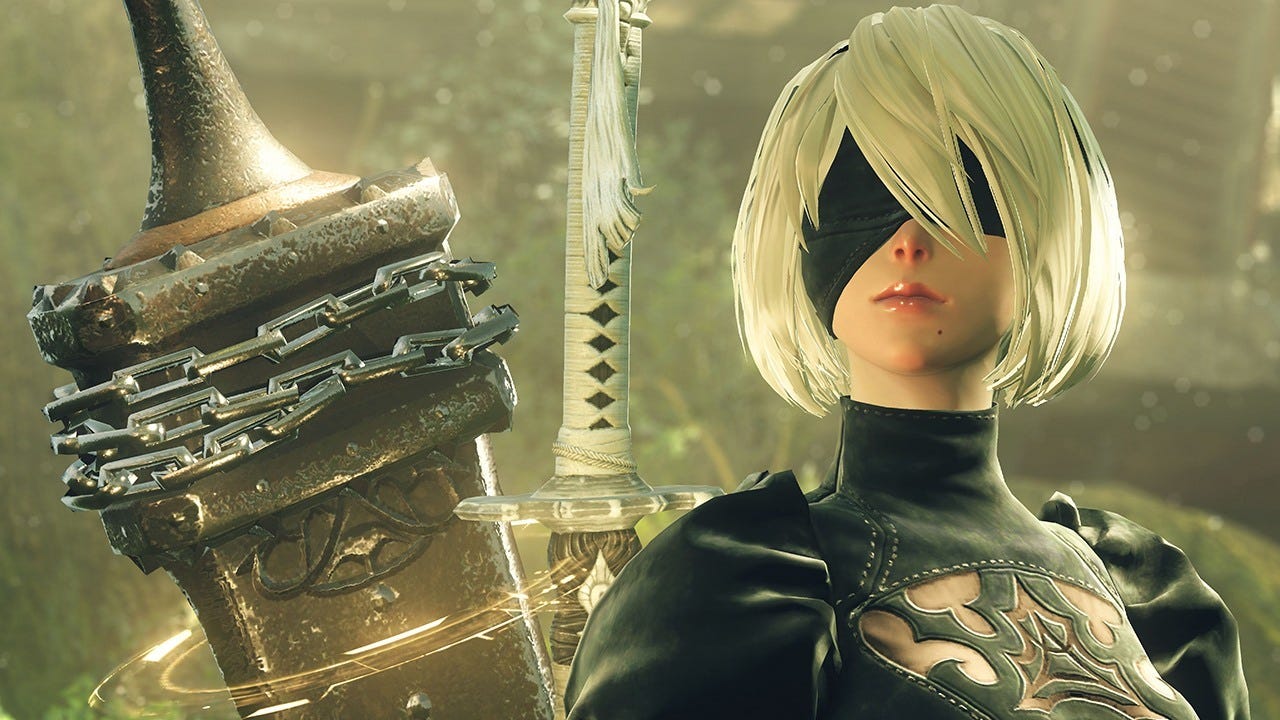
You start as 2B—cool, deadpan, black trench coat flapping like she’s auditioning for a cyberpunk ballet—and within 15 minutes, you’re slashing through chrome-limbed enemies with a katana, then switching to a machine gun mid-air, then diving into a bullet-hell sequence where your character shrinks to pixel size and dodges neon projectiles like it’s Ikaruga on espresso. Then, without warning, the screen goes black and white. A cursor blinks. You type “examine door” and get a paragraph of melancholy prose about rust, silence, and what it feels like to be left behind.
It’s not “genre-bending” in that polite, marketing-department way. It’s genre-spitting. One moment you’re parkouring up a crumbling office tower like you’ve had coffee with Spider-Man; the next, you’re stuck in a text adventure where choosing the wrong verb makes an NPC commit suicide—not for shock value, but because the game assumes you’ll understand why that matters. And somehow? It works. Because every shift feels earned, not gimmicky. The text segments aren’t filler—they’re breathing room. The bullet-hell isn’t just flash—it’s how the game shows you what war looks like when both sides are just following orders they don’t believe in.
The World Isn’t Just “Pretty”—It’s Haunted by Absence
Yeah, the ruins look amazing. Ivy crawling over collapsed skyscrapers, rain pooling in the hollow sockets of a fallen robot statue, sunlight catching dust motes in the cavernous belly of an abandoned mall. But what sticks with me isn’t the art direction—it’s how empty it all feels. Not sterile empty. Grieving empty.
You walk through a schoolyard full of motionless androids frozen mid-lesson. A playground swing creaks in the wind. A single notebook lies open on a desk, filled with careful, looping handwriting—“Why do we dream if no one watches us sleep?” You can’t pick it up. You can’t read more. You just stand there. And it hits you: this world wasn’t destroyed by war. It was abandoned, then slowly, politely, forgotten.
The scale is staggering, sure—but it’s the tiny details that gut you. The way a stray cat walks past you in the desert, unafraid. How a vending machine still lights up when you approach, even though the power’s been out for 200 years. This isn’t set dressing. It’s world-building as emotional archaeology.
Combat Feels Like Breathing—Until It Doesn’t
Let’s talk about how good it feels to move. Not “good for an action game.” Good like your hands remember it before your brain does. Light attack. Heavy attack. Dodge, whoosh, into a flip, then a mid-air kick that sends a drone spinning into a wall. Swap weapons with the D-pad (no pause, no menu, no friction), and suddenly you’re swinging a hammer twice your height, then firing homing missiles from your back-mounted pod.
There’s no stamina bar. No cooldowns slowing you down. Just rhythm, timing, and the quiet confidence that the game trusts you to keep up. PlatinumGames didn’t just make combat fluid—they made it musical. Enemies telegraph moves, but never in the same way twice. A tank might charge, then split into three smaller units. A flying foe might drop a swarm of drones, then become one of them. You learn to read intent, not patterns. And when it clicks? When you chain together ten moves without touching the ground? That’s pure dopamine. Simple, stupid, perfect.
But, and here’s the thing, it does break. Sometimes. There’s a late-game section where the camera fights you during a narrow platforming segment. Once, I got soft-locked in a boss arena because the AI decided my pod wasn’t “supposed” to fire at the weak point. These aren’t dealbreakers. They’re speed bumps. And honestly? They humanize the game. It’s not some flawless monolith. It’s a little messy. Like us.
The Story Doesn’t Explain—It Invites You to Stumble Through
Look. If you go in expecting clean answers, you’ll leave frustrated. Automata doesn’t hand you a thesis statement. It drops you into a philosophical dumpster fire and says, “Here’s a flashlight. Try not to burn yourself.”
You play as androids built to serve humans who’ve long since checked out. You fight machines who may or may not be developing consciousness. You meet allies who lie, betray, delete themselves, or quote Nietzsche while holding a flamethrower. The plot twists aren’t cheap shocks—they’re structural. Ending A, B, C, D… they don’t “unlock” extra lore. They reframe everything you thought you knew. I replayed the first hour after Ending E—not to “get it,” but because I needed to see the same hallway, the same dialogue, the same quiet hesitation in 2B’s voice, now knowing what I knew. It changed everything. Yet nothing was explained. Just… revealed.
Some moments land like a gut punch. Others feel like they’re trying too hard—like that one scene where a character monologues about loneliness while standing in front of a mirror that reflects nothing. Yeah, okay. We get it. But even the heavy-handed bits have weight, because the game earns its right to be earnest. It’s seen too much. So have you.
Who Is This For? Honestly? Anyone Who’s Ever Felt Like a Slightly Broken Thing Trying to Be Human
It’s not for people who want tidy endings. Or frictionless progression. Or games that treat you like a customer instead of a participant.
It is for people who’ve ever stared at their phone at 3 a.m. wondering why they bother replying to texts, or who’ve cried at a commercial, or who’ve whispered “I’m sorry” to a toaster they just unplugged forever.
Nier: Automata isn’t optimistic. It’s not cynical either. It’s tender. It treats despair and absurdity like siblings—same DNA, different temperaments. It gives you wings, then asks why you’d want to fly. It gives you a sword, then makes you question who you’re really fighting.
I played it twice. I’ll probably play it again. Not to “finish” it—but because I miss the quiet hum of that world. The way the music swells when you crest a hill and see the ocean, grey and endless, and realize you’re the only thing moving for miles.
Yeah, it’s weird. Yeah, it’s flawed. Yeah, it made me cry while kicking a robot in the face.
And honestly? That’s exactly why I love it.
References & Further Reading
Loading comments...
Loading similar articles...