
No Man’s Sky Is the Only Game That Makes Me Feel Like an Astronaut—And Also Like I’m Fighting My Controller
No Man’s Sky Is the Only Game That Makes Me Feel Like an Astronaut—And Also Like I’m Fighting My Controller I landed on a planet called Vespris-7 at 3:17 a.m. No alarm. No coffee.
No Man’s Sky Is the Only Game That Makes Me Feel Like an Astronaut—And Also Like I’m Fighting My Controller

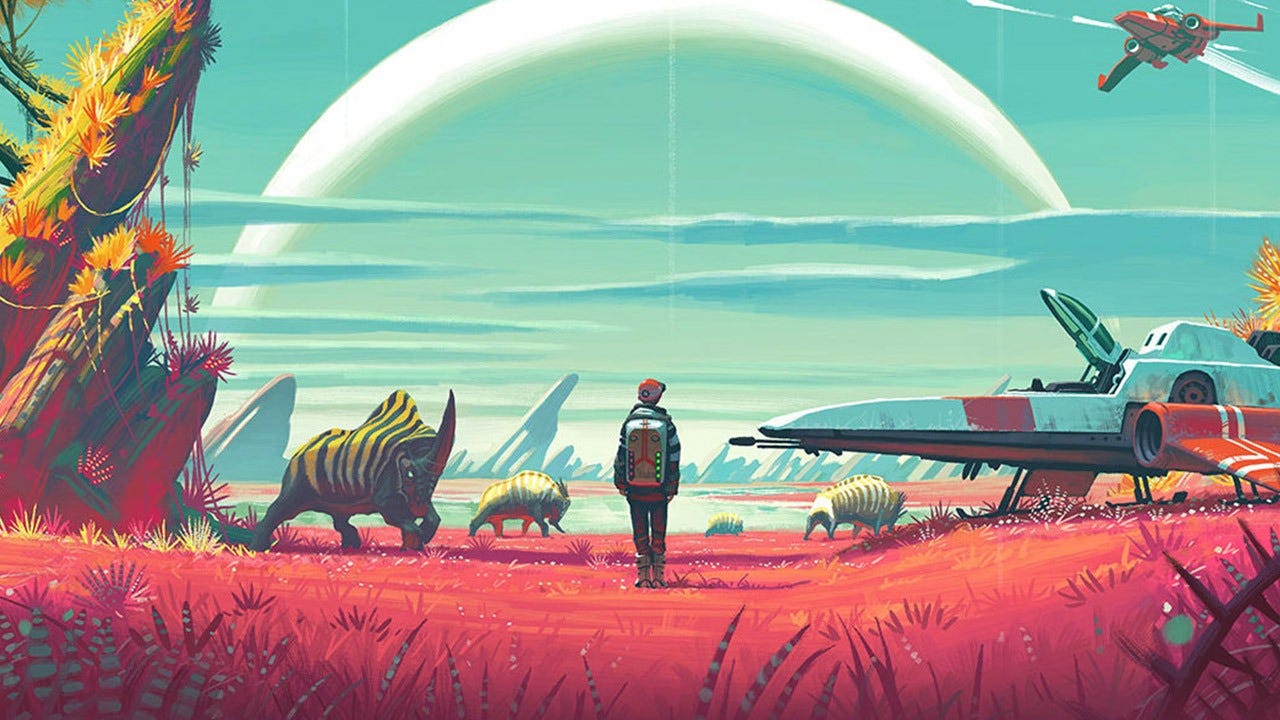
I landed on a planet called Vespris-7 at 3:17 a.m. No alarm. No coffee. Just me, a cracked screen on my PS5 controller, and a sky so thick with stars it looked like someone had spilled glitter into wet ink. I stepped out of my ship, crouched to scan a glowing blue fungus, then stood up—and watched my little astronaut silhouette shrink against a double sunset, one orange, one violet, hanging low over jagged obsidian cliffs. A six-legged lizard with iridescent scales ambled past, ignored me, and started licking a rock. I didn’t take a screenshot. Didn’t post it anywhere. Just stood there, breathing, until my suit oxygen ticked down to 82%.
That’s the thing about No Man’s Sky. It doesn’t tell you it’s special. It just… is. And then, five minutes later, it makes you want to throw your controller into a lake because you’ve spent seventeen minutes trying to swap a plasma launcher for a pulse cannon in a menu that treats your thumbstick like a broken joystick on a 1998 Tamagotchi.
The Scale Isn’t the Gimmick—It’s the Baseline
Let’s get this out of the way: yes, you can fly from the surface of a frozen methane world straight up, punch through atmosphere, drift across the black, and drop into orbit around a jungle moon—all without a single loading screen. Not even a fade-to-black. You just go. And no, it’s not “seamless” in some marketing-brochure sense. It’s real. You see the curvature of the planet fall away, watch clouds thin into haze, then vanish—and suddenly you’re tumbling through asteroid dust, your ship groaning softly as gravity shifts.
That moment still gets me. Every time. Even after 200+ hours across four years and three major updates. It’s not flashy. There’s no music swell. No voiceover whispering “behold the infinite.” It just happens, quiet and matter-of-fact—like opening a door and stepping onto another continent. Which, technically, you just did.
But here’s what nobody talks about enough: the scale only works because the game refuses to treat it as spectacle. It’s not about distance—it’s about consequence. Land on a toxic world? Your hazard suit drains faster if you forget to upgrade its filters. Try to mine plutonium near a geothermal vent? One wrong step and your exosuit overheats while your ship sits uselessly in orbit, 20 klicks up. The universe isn’t designed to impress you. It’s designed to function. And that’s why it sticks.
“Teach Me How to Play” Is Apparently a Foreign Phrase
The tutorial gives you a jetpack, tells you to hit R1 to mine, and says “your ship can jump.” Cool. Great. Thanks.
What it doesn’t tell you:
- That holding L1 while mining toggles between resource types (and that forgetting to do it means you’ll spend three hours gathering carbon instead of the chromatic metal your freighter needs).
- That your ship’s hyperdrive range depends not just on fuel, but on where you slot the warp cell in the engine grid—and that misplacing it by one node drops your jump distance by 40%.
- That your multitool has three separate modes (mining, scanning, combat), and switching between them requires a double-tap combo no one discovers organically. I learned it from a Reddit comment posted in 2018.
Hello Games didn’t forget to teach us. They assumed we’d reverse-engineer their UI like cryptographers cracking Cold War ciphers. The inventory system is the worst offender: three separate grids (suit, ship, tool), all navigated with a sluggish, non-snapping cursor. Trying to move a photon cannon from your ship’s weapon bay to your hand mid-combat? Good luck. You’ll be dodging fire while your thumbstick drifts helplessly between two identical-looking slots like it’s auditioning for The Office’s “Dwight tries to use a computer” scene.
And don’t get me started on dialogue trees. Yes, actual conversations, with NPCs. You pick responses using that same cursed cursor. On a gamepad. With no visual feedback until you land squarely on the option. I once accidentally told a space trader I’d “betray the Galactic Federation” instead of “accept the mission” because my stick wobbled left for half a second. He shot me. Fair? Maybe. Fun? Absolutely not.
Combat Feels Like Filing Taxes While Being Chased by Wasps
Shooting things in No Man’s Sky is fine—if your idea of fun is reloading every nine seconds, watching your auto-aim glitch out when a sentinel drone ducks behind a rock, then frantically mashing buttons to open your inventory while taking damage so you can swap ammo types.
There’s no weight to it. No feedback. Your pulse rifle sounds like a stapler full of static. Enemies don’t flank. They don’t take cover. They run in a straight line, stop at arm’s length, and swing. Even the “boss” sentinels, the ones with laser cannons, just hover, rotate slowly, and fire in predictable arcs. You learn their patterns in under two minutes. Then you grenade them. Or hide behind a boulder. Or, honestly? Just walk away. Their AI aggression timer resets after ~12 seconds. I’ve stolen entire mineral deposits while being “pursued” by a squad of elite drones who collectively forgot I existed before I reached my ship.
Worse: weapon mods are mostly pointless. Want a shotgun blast? Sure—but now your aim assist stutters every time you fire. Want ricochet bolts? Congrats! You’ve invented the most unreliable sniper mechanic in gaming history. Try hitting anything with a bounce shot outdoors. Go on. I’ll wait. (Spoiler: you won’t.)
The Quiet Magic Is in the Mundane
Here’s where I soften—just a little.
That weird purple bird that sings in harmonic thirds when it rains? Real.
The way coral reefs on ocean worlds pulse with bioluminescence only at night? Real.
The fact that every single planet has unique weather systems—acid storms, crystalline snow, magnetic auroras that interfere with your scanner—and none of it’s scripted? Yeah. Real.
You don’t “discover” these things. You stumble into them. You’re trying to repair your ship’s landing gear, get caught in a sudden sandstorm, take shelter in a cave—and then notice the walls aren’t stone. They’re fossilized whale ribs. From a creature that went extinct 12 million years ago. On this planet. And no one else has seen it. Not yet.
That’s the quiet miracle. Not the scale. Not the tech. The loneliness. The sense that you’re not playing a game—you’re keeping a logbook. A real one. With bad handwriting and crossed-out notes and coffee stains on the margins.
Who’s This For? Not Everyone. But Maybe You.
Look—I won’t pretend No Man’s Sky is for people who want tight controls, intuitive systems, or combat that feels satisfying. It’s not. It’s clunky. It’s opaque. It asks more of your patience than your skill.
But if you’ve ever stared at the night sky and felt that weird, quiet ache, not wonder, exactly, but recognition, then this might be the only game that answers back.
It’s for the person who’d rather spend an hour watching lichen grow on a cliff face than rush toward a quest marker.
For the player who finds peace in routine: refuel, rescan, re-calibrate, repeat.
For anyone who’s ever wanted to feel small—not powerless, not scared, but small, in the warm, humbling way of standing on a beach and realizing the sand under your feet is older than every human language combined.
It’s flawed. Deeply. But it’s also alive. And sometimes, that’s more than enough.
So yeah—I still curse at the inventory menu. I still rage-quit after misplacing a warp cell. But then I look up. And there it is: my ship, tiny and silver, glinting in orbit. Waiting.
And I go back out.
References & Further Reading
Loading comments...
Loading similar articles...