
Link’s Awakening Isn’t a Remake — It’s a Love Letter Written in Plastic and Fog
Link’s Awakening Isn’t a Remake — It’s a Love Letter Written in Plastic and Fog I replayed Link’s Awakening on Game Boy Color in 2014.
Link’s Awakening Isn’t a Remake — It’s a Love Letter Written in Plastic and Fog

I replayed Link’s Awakening on Game Boy Color in 2014. Not because I was nostalgic, I’d never even finished it back in ’98, but because my kid found the cartridge in a drawer, held it up like it was radioactive, and asked, “Dad, why does this guy look like he’s made of lint?” I laughed, popped it in, and got stuck for three hours trying to figure out how to open a chest in the Mysterious Forest. Not because it was hard. Because I had no idea what I was supposed to do — and that, honestly, is half the point.
This 2019 Switch version? It fixes almost all of that. And somehow, it makes the game feel more like itself than ever before.
That Island Still Smells Like Wet Cardboard and Daydreams
Koholint hasn’t changed. Not really. The layout’s identical — same crooked path from Mabe Village to Ukuku Prairie, same suspiciously convenient shortcut behind the library, same weirdo who lives in a tree and sells you a pineapple for 100 rupees (why? nobody knows). Even the timing of certain events — like when that one owl shows up at exactly 3:00 AM if you’re standing in the right spot — is preserved down to the frame.
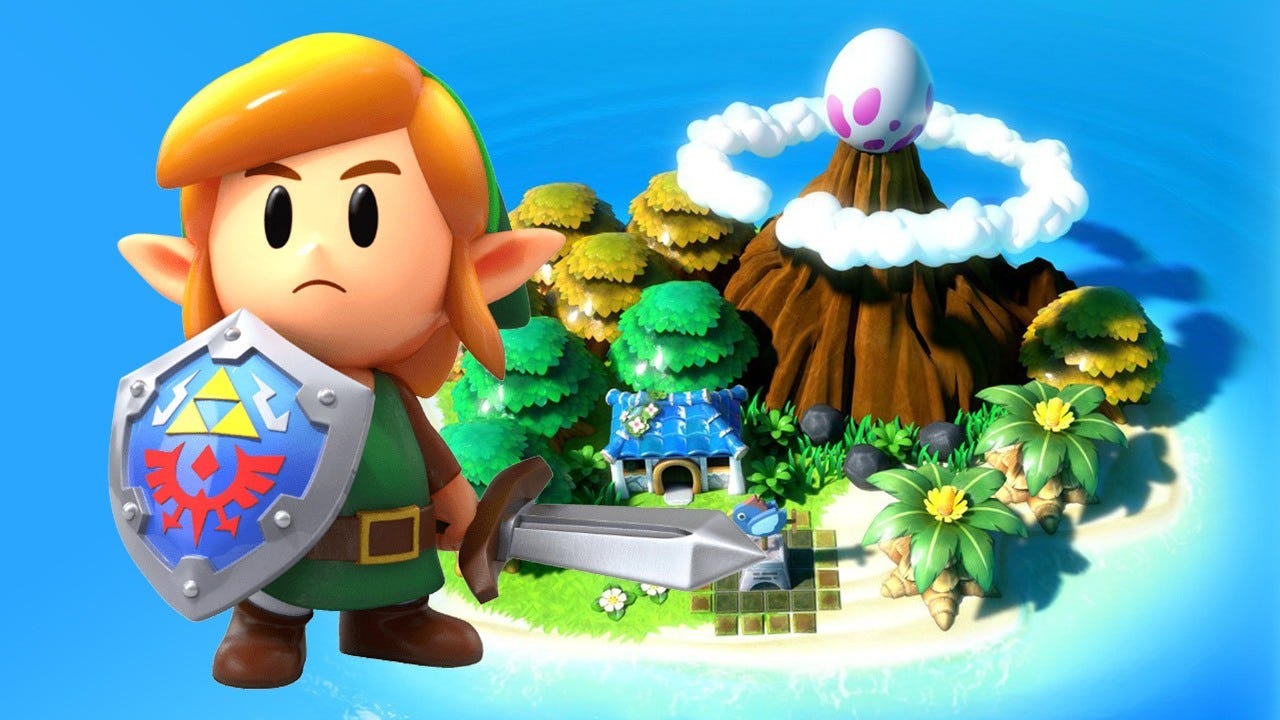
What has changed is how much the island breathes. The original felt like flipping through a flipbook drawn by a sleep-deprived art student. This one feels like walking around a diorama someone built in their garage — slightly wobbly, deliberately handmade, full of little imperfections that make it feel lived-in. Grass sways. Clouds drift lazily. Rain doesn’t just fall — it patters, then pools, then shimmers when Link walks through it. There’s no attempt to “realistically” render anything. Instead, everything’s rendered with a kind of gentle, knowing exaggeration — like a storybook illustration that winks at you when you turn the page.
And yeah, the framerate stutters sometimes. When five Moblins are swinging clubs while three Deku Babas snap and a screenful of leaves blow sideways? Yeah. It chugs. But here’s the thing: I didn’t care. Not once. Because the stutter feels of a piece with the world — like the island itself is just barely holding its shape together. Which, given the plot, is exactly how it should feel.
The Dungeons Got a Brain — and a Sense of Humor
Let’s be real: the original dungeons were charming, but they were also… thin. A lot of them boiled down to “find the key, find the locked door, find the other key, find the other locked door.” Puzzle logic was often less “aha!” and more “oh, I guess I’ll try every square in this room until something happens.”
Not anymore.
The Chamber Dungeons — a new optional mode unlocked after finishing the main story — are where Nintendo quietly slipped in some of the smartest, most satisfying dungeon design in the entire Zelda canon. You build your own mini-dungeons, tile-by-tile, using abilities you’ve unlocked. Want to force players to use the hookshot and the boomerang and the mirror shield in sequence? Go ahead. Want to make a room where the only way forward is to lure a Stalfos into stepping on a switch while dodging a rolling boulder while keeping your lantern lit? Sure. It’s basically Zelda Lego — tactile, immediate, and shockingly deep.
But even the main story dungeons got subtle, surgical upgrades. The Face Shrine now has actual environmental storytelling — statues shift with your movements, not just because the script says so. The Angler’s Tunnel uses water physics meaningfully, not just as a visual gimmick. And the Eagle’s Tower? That final puzzle, the one where you have to rotate the whole tower, isn’t just clever. It’s satisfying in a way the original’s version wasn’t. You feel the gears click.
The Music Doesn’t Just Sound Better — It *Means* More
Minako Hamano’s original soundtrack was already legendary. Those melodies, especially the Wind Fish theme, burrowed into your skull and stayed there for weeks. But the remake doesn’t just upgrade the fidelity; it recontextualizes the music.
That overworld theme? Now it swells with strings and woodwinds when you crest a hill and see the whole island laid out below you — but drops to just a solo piano when you’re wandering alone at night, listening to crickets and distant waves. The Ballad of the Wind Fish plays in fragments throughout the game — hummed by NPCs, whistled by birds, echoing faintly in empty rooms — like the island itself is remembering its own dream.
And the boss themes? They don’t just get louder. They get weirder. The nightmare sequences, especially the final confrontation, layer dissonant choral harmonies over familiar motifs until the music feels like it’s unraveling with you. It’s not background noise. It’s emotional scaffolding.
It’s the Only Zelda Game That Lets You *Stop*
Here’s what nobody talks about: Link’s Awakening is the only Zelda game where doing nothing feels like part of the adventure.
You can spend ten minutes watching seagulls circle above Toronbo Shores. You can trade a Yoshi doll for a mermaid scale, then trade that for a piece of driftwood, then give the driftwood to a depressed ghost who finally tells you where a secret cave is. You can sit on a bench in Mabe Village and watch Link’s neighbors argue about fishing bait. You can walk into the Dream Shrine and just… stare at the mural for five minutes.
There’s no pressure. No timer. No “the world is ending right now” urgency. Just this quiet, persistent sense that you’re inside someone else’s half-remembered dream — and that lingering, observing, poking at the edges is how you understand it.
That’s rare. Especially in a franchise that’s spent the last decade sprinting toward spectacle.
Who Is This For?
Not the “Zelda completionist” who needs every shrine mapped, every Korok seed collected, every weapon upgraded to max. Not the player who treats games like spreadsheets.
This is for people who still remember how it felt to hold a Game Boy in the dark, squinting at the green glow, pretending the static was fog. For people who think “haunting” and “cozy” aren’t opposites. For people who like their fantasy served with a side of absurdity — yes, you do ride a Chain Chomp like a dog on a leash, and yes, it does wag its tail.
It’s also for people who’ve been burned by remakes that sand off all the rough edges — the ones that mistake “polish” for “personality.” Link’s Awakening keeps every awkward cutscene, every weird line of dialogue (“I am the man who sells the wind!”), every moment where the game just… pauses, like it’s waiting for you to catch up.
I finished it last week. Didn’t rush. Didn’t skip cutscenes. Took screenshots of random trees. Sat on a rock for ten minutes watching rain fall on the beach.
Then I turned it off. Didn’t feel the urge to start again. Didn’t feel the itch to “optimize” or “speedrun” or “100%.” Just felt… settled.
Like waking up from a good dream — the kind where you remember the feeling longer than the plot.
That’s not easy to pull off.
This game did it.
Twice.
References & Further Reading
Loading comments...
Loading similar articles...