
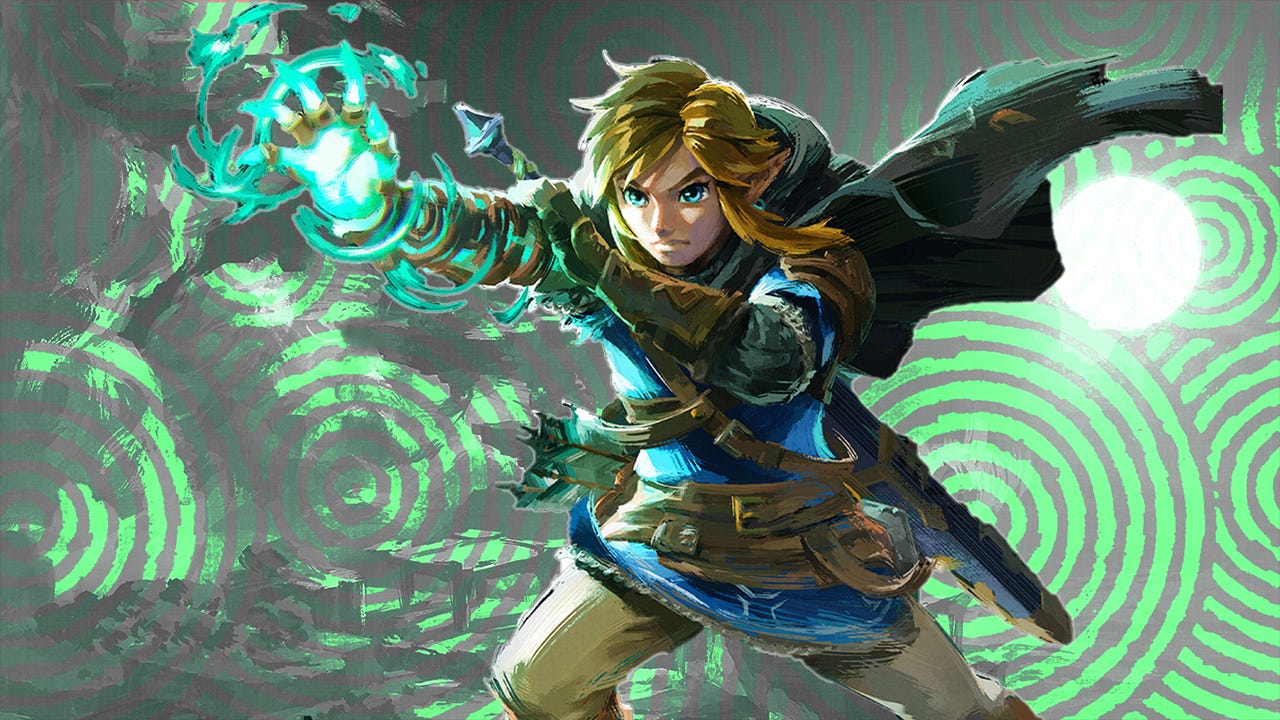
Tears of the Kingdom Isn’t a Sequel — It’s a Rewriting

I cried twice in Tears of the Kingdom. Not the “oh god my dog died” kind. More like: Oh. Oh no. I just built a glider out of three wooden planks, a fan, and a rock — and it worked. And now I’m flying over a waterfall into a cave that wasn’t on any map, and there’s a dragon sleeping under a bridge made of coral and lightning, and I have no idea how any of this is possible.
That’s not emotion. That’s vertigo.
Let me be clear: I played Breath of the Wild obsessively for 27 months. I’ve got a shrine completion spreadsheet. I know where every Korok seed hides behind a shrub you’d swear was just decorative. I once spent three hours trying to get a boulder to roll exactly onto a switch so I could open a chest containing a single rusty sword. I loved it. I still do. But playing Tears felt less like returning home and more like walking into your childhood bedroom and finding the walls had grown wings.
The Sky Isn’t Empty Anymore — It’s *Occupied*
You remember the sky in BotW? Big, beautiful, quiet. A place for dragons to glide through like they owned the airspace — which, honestly, they did. Tears doesn’t add clouds. It adds layers. There’s the surface (still gorgeous, still full of windmills and goats who judge you), then the Depths (a grim, fungal hellscape where light dies and stamina drains faster than your will to live), and then — the Sky Islands.
Not floating rocks. Not aesthetic fluff. Actual islands. Some are the size of villages. Others are just a single crumbling altar with a shrine glowing softly in the center. You find them by scanning the horizon with your Sheikah Slate — and yes, you will scan the horizon constantly, because half the time you’re not looking for something. You’re looking for where the sky broke.
And it broke. Not metaphorically. Something cracked Hyrule open like an egg. Chasms yawned. Ruins rose. And suddenly, the world wasn’t a sphere you walked around — it was a stack of worlds you could fall through, climb up, or launch into.
This isn’t verticality as a gimmick. It’s verticality as philosophy. Want to cross a canyon? You can glide — sure. Or you can build a catapult out of a wheel, a spring, and a log, strap yourself to it, and fire yourself sideways into the next island like a very confused squirrel. It works. It’s ridiculous. And Nintendo lets you.
Build Mode Is Either Genius or a Glitch They Forgot to Patch
Look. I don’t trust building systems. I’ve seen too many games slap “crafting” on top of a checklist and call it depth. Tears doesn’t do that. It gives you Zonai devices — little glowing orbs that emit wind, stick to surfaces, spin wheels, or shoot lasers — and says: Here. Go nuts.
You don’t unlock recipes. You discover physics. You learn that a fan + a boat hull = forward motion. That two fans facing opposite directions = a hovercraft. That attaching a rocket to a sled makes it explode, but if you attach it under a flat board with four wheels? You’ve got a land-speed record contender.
It’s messy. It’s janky. Your first vehicle will veer off a cliff because you didn’t account for torque. Your second will catch fire because you accidentally fused a flame emitter to a wooden frame. But the third? The third might actually fly. And when it does — when you’re airborne, holding the left stick like you’re praying, watching your creation wobble over a chasm while a Lynel stares up at you in what I swear is existential confusion — that’s not gameplay. That’s aliveness.
And it’s everywhere. Not just vehicles. You can fuse weapons mid-combat. Stick a frost blade to a spear and freeze enemies solid mid-swing. Attach a bomb to a bowstring and fire it like a mortar round. The game doesn’t gate these ideas behind skill trees or quests. It hands you the toolbox and walks away.
Which means: yes, it’s unbalanced. Yes, you can cheese the final boss with a 30-foot rotating drill made of metal rods and spinning fans. And yes, that feels slightly absurd. But absurdity is part of the point. This isn’t about balance. It’s about permission.
The Story Doesn’t Ask You to Care — It Makes You *Want* To
Let’s be real: Zelda stories rarely swing for the fences. They’re serviceable. Comforting. Like a well-worn sweater. Tears starts with a funeral, Zelda’s, and then immediately drops Link into a nightmare version of Hyrule where time is fraying, people are vanishing, and ancient tech hums beneath the soil like buried nerves.
The twist isn’t what happens. It’s how much it matters to the world. In BotW, calamities were backstory. Here, they’re texture. You see the scars — families rebuilding homes on stilts above flooded plains, scholars mapping the Depths like they’re charting a new continent, kids drawing pictures of the Sky Islands on cave walls. The lore isn’t delivered in cutscenes. It’s etched into the environment, whispered in side quests, buried in journals you find inside rusted lockers in abandoned Zonai labs.
And Zelda? She’s not waiting. She’s gone, yes — but she’s also everywhere. Her notes are pinned to bulletin boards. Her voice echoes in recordings. Her research forms the backbone of half the upgrades you’ll unlock. For once, the princess isn’t the MacGuffin. She’s the architect. And that changes everything.
Shrines? Nah. Try “Caves of Questionable Judgment”
Shrines are back — but they’re weirder. Less “solve this block puzzle,” more “convince this sentient mushroom to let you borrow its spores so you can grow a bridge across acid.” One has you navigating a maze by listening to soundwaves bounce off invisible walls. Another forces you to rewind time only for specific objects, turning a simple platforming section into a logic knot that made me groan, laugh, and then text my brother a 47-word rant about causality.
They’re shorter, denser, and often tied to Zonai tech in ways that feel fresh instead of familiar. And they’re everywhere. Not just on land. You’ll drop into a cave in the Depths, solve a shrine underwater using magnetic currents, then resurface to find a Sky Island hovering directly overhead — and yes, you can glide up there mid-quest.
Who Is This For?
Not for people who want tight, curated experiences. Not for players who need hand-holding or constant narrative reinforcement. And definitely not for anyone who thinks “open world” means “a bunch of icons on a map.”
Tears is for the ones who stop climbing a mountain because they saw a bird fly behind it and wonder what’s over there. For the people who try to cook three different meats at once just to see if the pot explodes. For the folks who whisper “what if…” and then spend 45 minutes testing it.
It’s flawed. Some Zonai devices feel underused. The Depths get monotonous after six hours. The camera still fights you on narrow bridges. And yeah — the story stumbles in the third act, leaning too hard on exposition dumps when it should’ve trusted the imagery.
But none of that matters when you’re standing on a floating island at sunset, your homemade gyrocopter sputtering beside you, watching a Lynel gallop across a cloud bridge 200 meters below, and realizing, with absolute certainty, that no other game on Earth would let you do this.
Not even close.
So go play it. Skip the tutorial. Ignore the quest log. Climb the tallest thing you see. Fall. Build something to catch you. And when it works, when it all works, don’t take a screenshot.
Just breathe.
Because this isn’t just the best Zelda since Ocarina.
It’s the first game in years that made me believe, genuinely, that anything is possible —
as long as you’ve got glue, gravity, and a terrible idea you refuse to let go of.
References & Further Reading
Loading comments...
Loading similar articles...